GEORGE STRAIT AND WRANGLER: THE JEANS THAT BECAME PART OF THE KING’S IMAGE
Introduction
For more than three decades, two names have seemed almost inseparable in country music: George Strait and Wrangler.
Long before Strait became known around the world as the “King of Country Music,” the Texas native was already surrounded by the traditions that would later define his public image. In his world, cowboy clothing was not a costume. It was simply what a Texas cowboy wore.
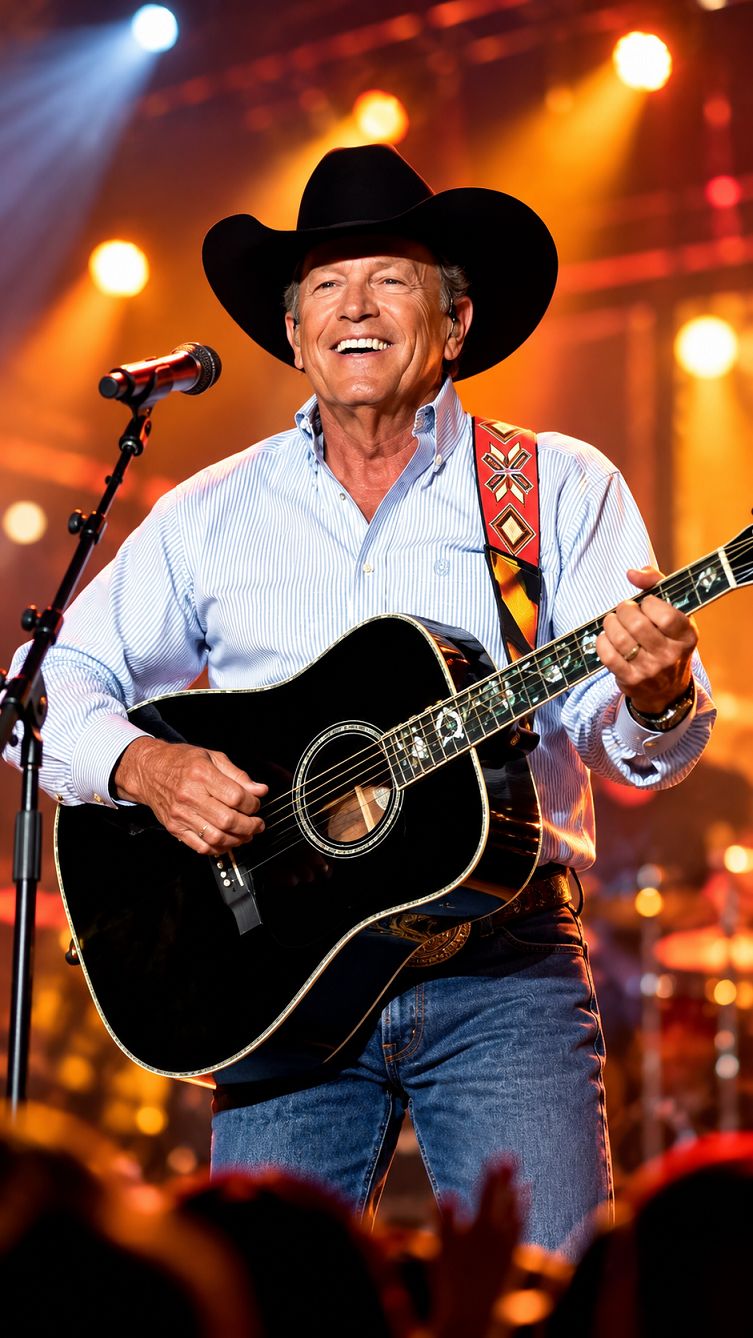
Strait has often embraced that tradition openly. His preferred look has remained remarkably consistent: starched Wrangler jeans, a crisp starched shirt, a well-shaped cowboy hat, and a good pair of boots.
On stage, he rarely needed anything more.
That simplicity became part of his identity.
In an era when country stars increasingly experimented with fashion, George Strait stayed remarkably close to the look of the American West. He did not need elaborate costumes or dramatic changes between performances. His clothes communicated something immediately recognizable: Texas, tradition and authenticity.
Wrangler fit naturally into that image.
The brand had long been associated with rodeo riders, ranchers and working cowboys, making it a natural match for an artist whose music was deeply connected to the culture of the American West. For Strait, wearing Wrangler was not simply about having the right jeans for a performance. It was part of maintaining a visual connection to the world that shaped him.
And that consistency mattered.
When audiences saw George Strait walk onto a stage wearing his familiar hat, jeans and boots, they knew exactly who they were about to hear. There was no need for reinvention. The man in front of them looked much like the cowboy they had seen years earlier.
That became increasingly powerful as his career grew.
Strait’s music helped preserve a traditional side of country music during periods when the genre was changing rapidly. His appearance reinforced the same message. He could become one of the biggest stars in country music without abandoning the visual language of Texas.
There is also something deeply American about the relationship between Strait’s music and his clothing. The jeans are practical. The boots are functional. The hat carries history. Nothing about the look seems designed simply to attract attention.
Instead, it feels lived in.
That may be one reason the image has lasted.
George Strait has spent decades performing for enormous audiences, collecting awards and recording songs that became standards of modern country music. Yet his basic stage appearance has remained familiar enough that a single photograph can immediately identify him.
The Wrangler jeans are only one part of that picture, of course. But they have become part of the visual shorthand associated with the King of Country.
For younger artists, fashion can sometimes become a carefully constructed part of a career. For George Strait, the opposite has often been true. His style became iconic because he did not appear to be trying to make it iconic.
He simply kept wearing what felt right.
And perhaps that is the most fitting connection between George Strait and Wrangler.
Both represent a version of country music built around durability rather than trends. Neither requires constant reinvention to remain recognizable. Both are closely connected to the American West, where clothing has traditionally been about usefulness, identity and pride.
More than 30 years later, the image remains powerful: George Strait under the stage lights, a cowboy hat on his head, Wrangler jeans pressed sharp, boots firmly planted beneath him, and a country song waiting to begin.
The crown may have made him the King of Country Music.
But long before the crown, there were the boots, the hat—and the Wranglers.