THREE VOICES ROSE FOR DOLLY—AND THE OPRY SEEMED TO HEAR THE BEE GEES AGAIN
Introduction
There are certain moments in music that do not need a spectacular entrance. They do not require a dazzling stage, a wall of lights, or an announcement designed to make the audience gasp. Sometimes, all it takes is one familiar melody, one honest voice, and a second voice quietly finding its place beside it. And then, almost before anyone realizes what is happening, the room begins to remember.
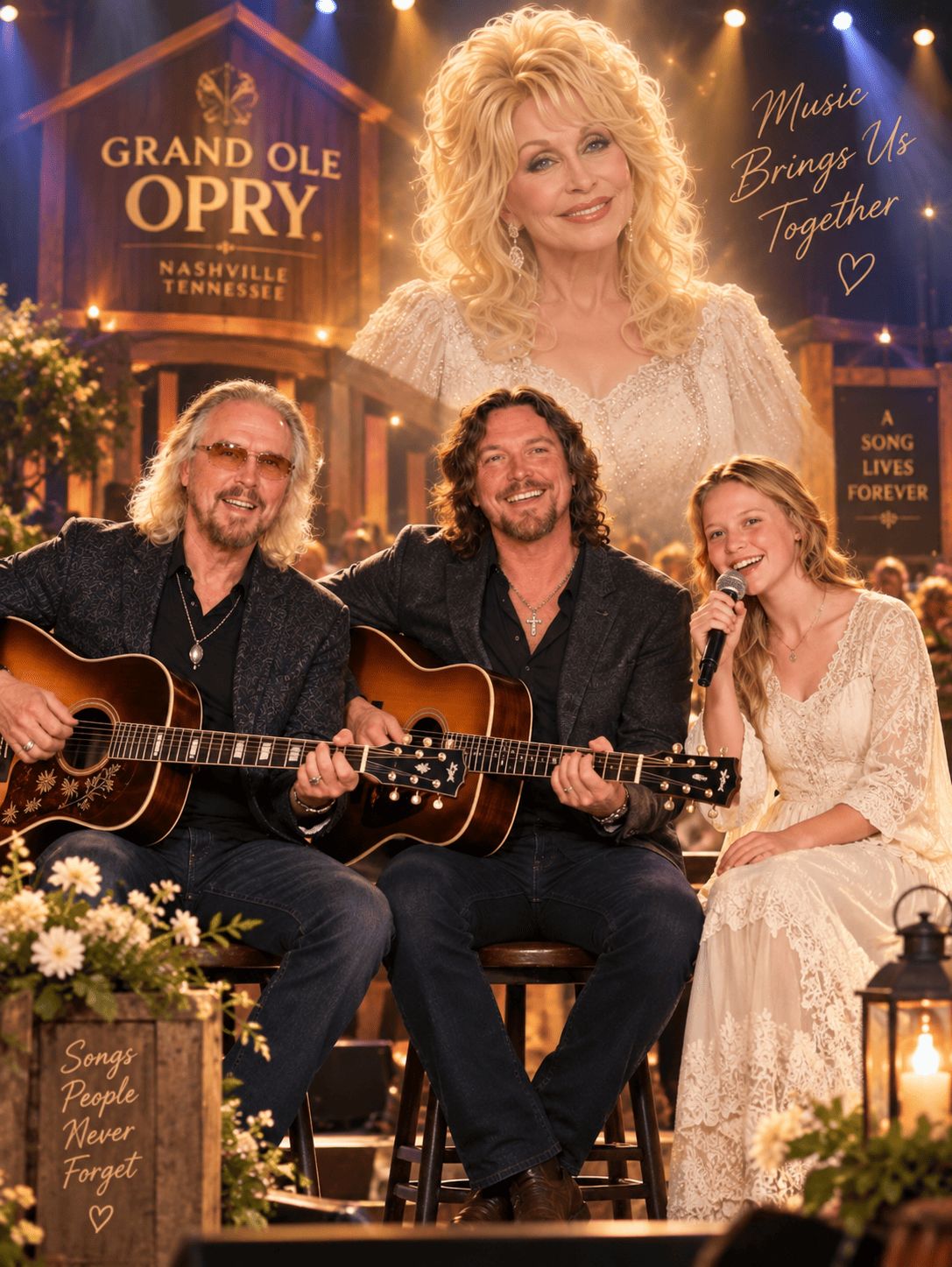
That is the feeling at the heart of this imagined musical tribute to Dolly Parton—a moment envisioned on the historic stage of the Grand Ole Opry, where three voices come together and create an unexpected echo of another legendary trio: Barry, Robin and Maurice Gibb, the brothers whose harmonies helped define the sound of the Bee Gees.
It is important to say plainly that this is an imagined tribute, inspired by the musical legacies of Dolly Parton and the Bee Gees rather than a report of an actual Opry performance. Yet the imagined scene feels believable because the emotional connection between these artists is rooted in something real: their extraordinary understanding of melody, harmony, memory and the human experience.
For generations of listeners, Dolly Parton has represented far more than country music. Her songs have become small pieces of family history. People heard them in living rooms, on radios during long drives, at family gatherings and in quiet moments when life seemed particularly heavy. Dolly possessed a rare ability to take something deeply personal and turn it into something millions of people could understand.
That gift can be heard in songs such as “Coat of Many Colors,” where memories of childhood become a story about dignity, family and love. It can be heard in “I Will Always Love You,” a song whose emotional strength comes not from excess, but from the sincerity of its words. Dolly understood that the simplest truth, when delivered honestly, can stay with a listener for decades.
The Bee Gees approached music from a different musical landscape, but their understanding of emotional connection was remarkably similar. Barry, Robin and Maurice Gibb developed a vocal identity in which three individual voices could become something larger than any one singer. Their harmonies were instantly recognizable, and their music traveled across generations and musical boundaries.
That is what makes the imagined Opry moment so intriguing.
Picture the stage after the opening introduction. The lights soften. The audience settles into silence. One singer begins the first phrase of a Dolly song. There is no attempt to overpower the melody. The words are allowed to breathe.
Then a second voice enters.
A third follows.
Suddenly, the song is no longer simply being performed. It is being remembered.
For older listeners who grew up hearing the Bee Gees, that first meeting of voices could create an almost instinctive reaction. The sound might bring back memories of Barry, Robin and Maurice Gibb standing together, their voices moving around one another with remarkable precision. Yet this imagined tribute would not need to imitate the brothers. Its beauty would come from allowing their influence to exist as an emotional echo rather than a copy.
And that distinction matters.
Great music does not survive because every new singer reproduces the original performance exactly. It survives because another generation finds a way to make an old song meaningful again.
That is also part of Dolly Parton’s remarkable legacy.
Her career has always demonstrated that music can travel. A song may begin in the mountains of Tennessee and eventually find listeners thousands of miles away. A country melody can become a pop standard. A personal story can become a shared memory. A voice associated with one particular era can continue speaking to people who were not even alive when the song was first recorded.
The Grand Ole Opry is an especially fitting imagined setting for such a tribute. The Opry carries its own history of voices, traditions and generations. It represents a place where the past does not necessarily disappear when the next generation arrives. Instead, one artist stands where another once stood, and the music continues.
That idea gives the imagined performance its emotional center.
Three singers stand together beneath the Opry lights. They are not trying to recreate history. They are acknowledging it.

One voice carries Dolly’s storytelling tradition.
Another brings warmth and depth.
The third creates the harmony that ties everything together.
For just a few seconds, listeners who know the Bee Gees’ history might recognize something familiar in the arrangement—the sensation of voices becoming inseparable, of individual singers disappearing into a larger musical conversation. It is the kind of sound that can make an audience stop thinking about technique and simply listen.
And perhaps that is why such a moment would mean so much to an older audience.
People who have lived with music for decades understand that songs collect memories.
A song can remind you of a parent who used to sing along with the radio. It can take you back to a particular car, a particular house, a particular season of life. Sometimes you may not have heard a song in twenty years, yet the first few notes can bring back a person or place with extraordinary clarity.
That is the quiet power of musical nostalgia.
It is not simply about remembering the past. It is about discovering that the past is still capable of speaking to the present.
In this imagined tribute, Dolly’s songwriting and the Bee Gees’ harmony meet not because their musical careers were identical, but because both understood the importance of connection.
Dolly connected with listeners through stories.
The Bee Gees connected through harmony.
Both created music that could outlive the moment in which it was first heard.
As the imagined performance approaches its final refrain, the three singers come together more closely. The arrangement becomes fuller, but the emotion remains restrained. There is no need for theatrical exaggeration. The voices carry the moment.
Somewhere in the audience, an older listener may be remembering Dolly.
Another may be remembering the Gibb brothers.
Someone else may simply be thinking about a loved one who is no longer sitting beside them.
That is when the music becomes bigger than the performance itself.
The final note arrives.
And then comes silence.
Not empty silence.
Remembering silence.
The kind that follows a song when an audience needs a few seconds before applause feels appropriate.
Then the room responds.
Applause rises across the Opry.
It is not applause for the idea that the past can be recreated. It is gratitude for something more meaningful: the fact that the music remains.
That is the lasting promise of Dolly Parton’s legacy and the extraordinary vocal legacy of the Bee Gees. Their original voices belonged to their own time, but the songs they left behind continue to invite new voices into the conversation.
And perhaps that is why the imagined image of three voices rising for Dolly feels so powerful.
For one brief musical moment, the Opry would not simply be looking backward.
It would be listening forward.
The voices would belong to the present.
The memories would belong to generations past.
And somewhere between those two worlds, listeners might hear a familiar echo—the unmistakable feeling of three voices finding one another again.
Not the Bee Gees returning.
Not history being rewritten.
But music doing what it has always done best:
bringing yesterday into the room, giving today something to remember, and leaving tomorrow with a song.