DOLLY PARTON: The Unforgettable Journey of a Country Icon Who Turned Mountain Dreams Into a Global…
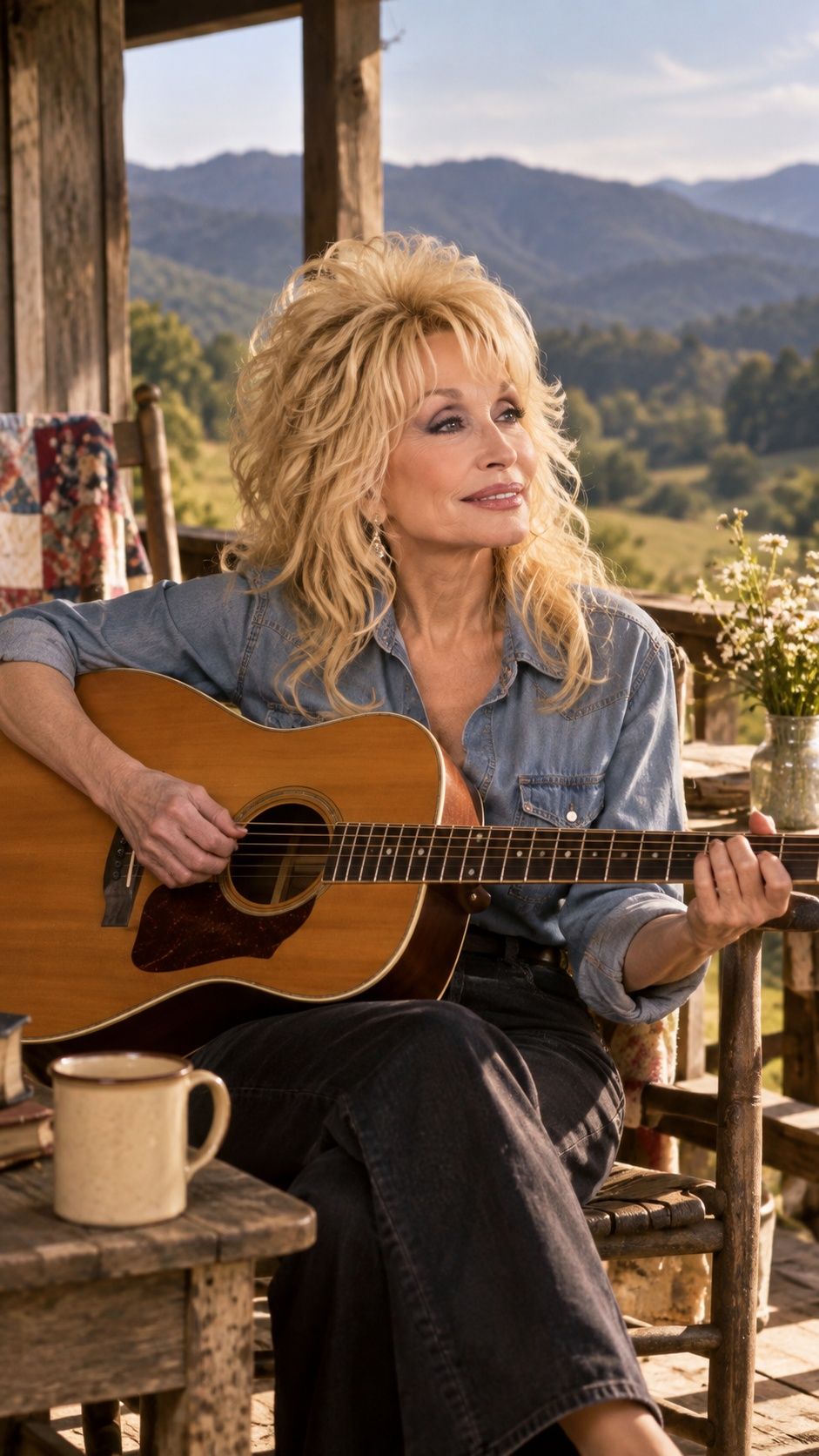
There are artists whose voices become familiar, and then there are artists whose voices seem to belong to an entire generation. Dolly Parton is both—and somehow much more. Her story begins in the mountains of East Tennessee, where poverty was real, family came first, and music could transform an ordinary room into a place filled with possibility. From those humble beginnings emerged a songwriter, performer, actress, entrepreneur, philanthropist, and cultural figure whose influence reaches far beyond country music.
What makes Dolly’s journey extraordinary is not simply the number of records she has sold or the awards she has received. It is the emotional honesty behind the songs. She has written about heartbreak without bitterness, ambition without shame, faith without preaching, and poverty without allowing it to define her worth.
Songs such as Jolene, Coat of Many Colors, I Will Always Love You, and 9 to 5 became powerful because they carried pieces of real human experience. Dolly could make listeners laugh, cry, remember home, or confront their own regrets—all within a few minutes.
Her success never erased where she came from. Instead, she repeatedly turned those memories into art. That may be the most enduring part of the Dolly Parton story: she did not leave her roots behind. She carried them with her.
The Mountain Roots Behind the Legend
To understand Dolly Parton, it is essential to understand the environment that shaped her imagination.
She was born in 1946 in Sevier County, Tennessee, and grew up in a large family in the Great Smoky Mountains. Her parents, Robert Lee Parton Sr. and Avie Lee Parton, raised their children with limited financial resources, but the household was rich in music, storytelling, humor, and family traditions.
Those early experiences became some of Dolly’s most important creative material.
Rather than treating poverty as something that had to be hidden, she transformed it into something meaningful. Her famous song Coat of Many Colors is one of the clearest examples. The song recalls a coat made for her from pieces of fabric, turning what could have been a painful childhood memory into a story about love, dignity, and family.
That ability to find emotional beauty inside difficult circumstances became one of her defining artistic qualities.
A Voice That Was Never Only About Singing
When people discuss Dolly Parton, they often begin with her distinctive voice. It is instantly recognizable—bright, emotional, playful, and capable of extraordinary vulnerability.
But her greatest strength may have been her songwriting.
Dolly Parton understood that a great country song does not need complicated language. It needs emotional truth.
I Will Always Love You demonstrates this perfectly. Originally written and recorded by Dolly, the song became one of the most famous compositions in modern popular music after Whitney Houston recorded her monumental version for The Bodyguard.
Yet Dolly’s achievement was not simply writing a song that another superstar could turn into a global hit. The original composition already contained the emotional architecture necessary for that transformation: separation, gratitude, sadness, acceptance, and enduring affection.
Her songwriting repeatedly demonstrated the same instinct. She could take ordinary situations and reveal the extraordinary emotions hiding inside them.
Jolene and the Power of Emotional Simplicity
Few country songs are as immediately recognizable as Jolene.
The premise is remarkably simple: a woman pleads with another woman not to take the man she loves.
But the song works because Dolly does not present the narrator as powerful or arrogant. Instead, she sounds vulnerable.
That vulnerability is crucial.
The narrator is not boasting that she can defeat her rival. She is admitting that she is afraid.
Dolly’s performance turns jealousy into something more complicated: insecurity, desperation, admiration, and love existing simultaneously.
The character of Jolene became larger than the song itself, entering popular culture as an almost mythical figure—the beautiful woman who represents everything the narrator fears losing.
That is the brilliance of Dolly’s writing. She rarely needs elaborate storytelling to create a complete emotional world.
From Country Star to Mainstream Icon
Dolly’s career expanded dramatically beyond traditional country music.
Her transition into film demonstrated another dimension of her personality. In 9 to 5, she appeared alongside Jane Fonda and Lily Tomlin, helping transform a workplace comedy into a cultural statement about women, employment, and power.
The title song became one of her signature recordings.
This period showed that Dolly could move between entertainment worlds without abandoning her identity.
She could stand on a country stage with a guitar, appear on a Hollywood set, write a heartbreaking ballad, or deliver a humorous television performance—and still feel unmistakably like herself.
That consistency mattered.
Many performers reinvent themselves by abandoning their previous identities. Dolly expanded hers.
The Intelligence Behind the Glamour
Dolly’s appearance has often become part of the public conversation: the elaborate hair, sparkling clothing, dramatic makeup, and unmistakable Southern glamour.
But focusing only on the visual image misses something important.
Behind the flamboyance is a remarkably disciplined business mind.
Dolly Parton understood branding long before modern celebrity culture turned personal identity into a commercial strategy.
She knew what made her recognizable.
She understood the importance of songwriting rights.
She built businesses around her name.
And she developed Dollywood into a major attraction that connected entertainment, tourism, Appalachian identity, and her own personal story.
The larger lesson is fascinating: Dolly did not simply become famous. She learned how to turn fame into an enduring institution.
Dollywood and the Return to Home
Perhaps one of the most meaningful chapters of Dolly’s career is her relationship with the region where she grew up.
Dollywood, located in the Smoky Mountains of Tennessee, is more than an amusement park carrying a celebrity’s name. It represents Dolly’s continuing connection to Appalachian culture.
Its success also reflects a recurring theme in her life: achievement did not require her to reject her origins.
Instead, she brought her origins onto the world stage.
The mountains that once represented economic hardship became associated with entertainment, tourism, music, family experiences, and opportunity.
In that sense, Dolly’s success became part personal achievement and part cultural storytelling.
A Career Built on Reinvention
One of the most remarkable things about Dolly Parton is longevity.
Her career has moved through generations of musical change.
She emerged during an era when country music was deeply connected to regional radio, traditional songwriting, and live performance. She remained relevant through the rise of television, blockbuster cinema, MTV-era pop culture, digital music, streaming, and social media.
Yet she never needed to chase every trend.
Instead, she kept returning to the same core ingredients:
storytelling, humor, melody, emotional honesty, and unmistakable personality.
That consistency allowed younger generations to discover her without needing to understand every chapter of her original career.
A teenager can hear Jolene today and immediately understand the emotion.
Someone discovering 9 to 5 can recognize its frustration and humor.
A listener hearing Coat of Many Colors can understand the importance of family.
And I Will Always Love You continues to demonstrate the extraordinary power of a simple farewell.
More Than a Country Music Figure
Dolly’s cultural influence eventually became much larger than music.
Her philanthropic work, particularly her commitment to childhood literacy through the Imagination Library, added another dimension to her public legacy.
The program’s central idea is beautifully simple: give children books.
That simplicity reflects something fundamental about Dolly herself.
She has repeatedly taken enormous ideas and expressed them through accessible, human gestures.
Music can change someone’s mood.
A book can change a child’s imagination.
A song can preserve a memory.
A gift can tell someone they matter.
These ideas appear repeatedly throughout Dolly’s career.
Why Dolly Parton’s Story Still Resonates
The reason Dolly Parton remains such a compelling figure is that her story contains contradictions without requiring them to be resolved.
She is glamorous but deeply connected to humble beginnings.
She is commercially successful but constantly associated with generosity.
She is playful and funny while also writing devastatingly sad songs.
She became a global celebrity without pretending she came from somewhere other than the mountains of Tennessee.
And perhaps most importantly, she has never treated vulnerability as weakness.
That quality can be heard throughout her music.
Her characters worry.
They lose people.
They become jealous.
They miss home.
They make mistakes.
They hope.
They keep going.
That is why Dolly’s songs have survived beyond their original eras. They are not really about fashion or musical trends. They are about people.
The Enduring Legacy of Dolly Parton
The legacy of Dolly Parton cannot be reduced to awards, chart positions, movie roles, business ventures, or famous songs.
Her deeper contribution is storytelling.
She showed that a person could come from extreme simplicity and still dream on an enormous scale. She demonstrated that country music could tell intimate stories while reaching audiences far beyond its traditional boundaries. And she proved that authenticity could coexist with spectacle.
Her greatest songs feel like small windows into larger lives.
A coat becomes a memory of a mother.
A beautiful stranger becomes a symbol of fear.
A farewell becomes an anthem of love.
A workday becomes a story about dignity.
A childhood in the mountains becomes the foundation of an international career.
That is the extraordinary journey of Dolly Parton.
She did not simply become a star.
She turned where she came from into part of what the world remembers—and in doing so, transformed personal memories, Appalachian storytelling, and country music into a legacy that continues to cross generations.